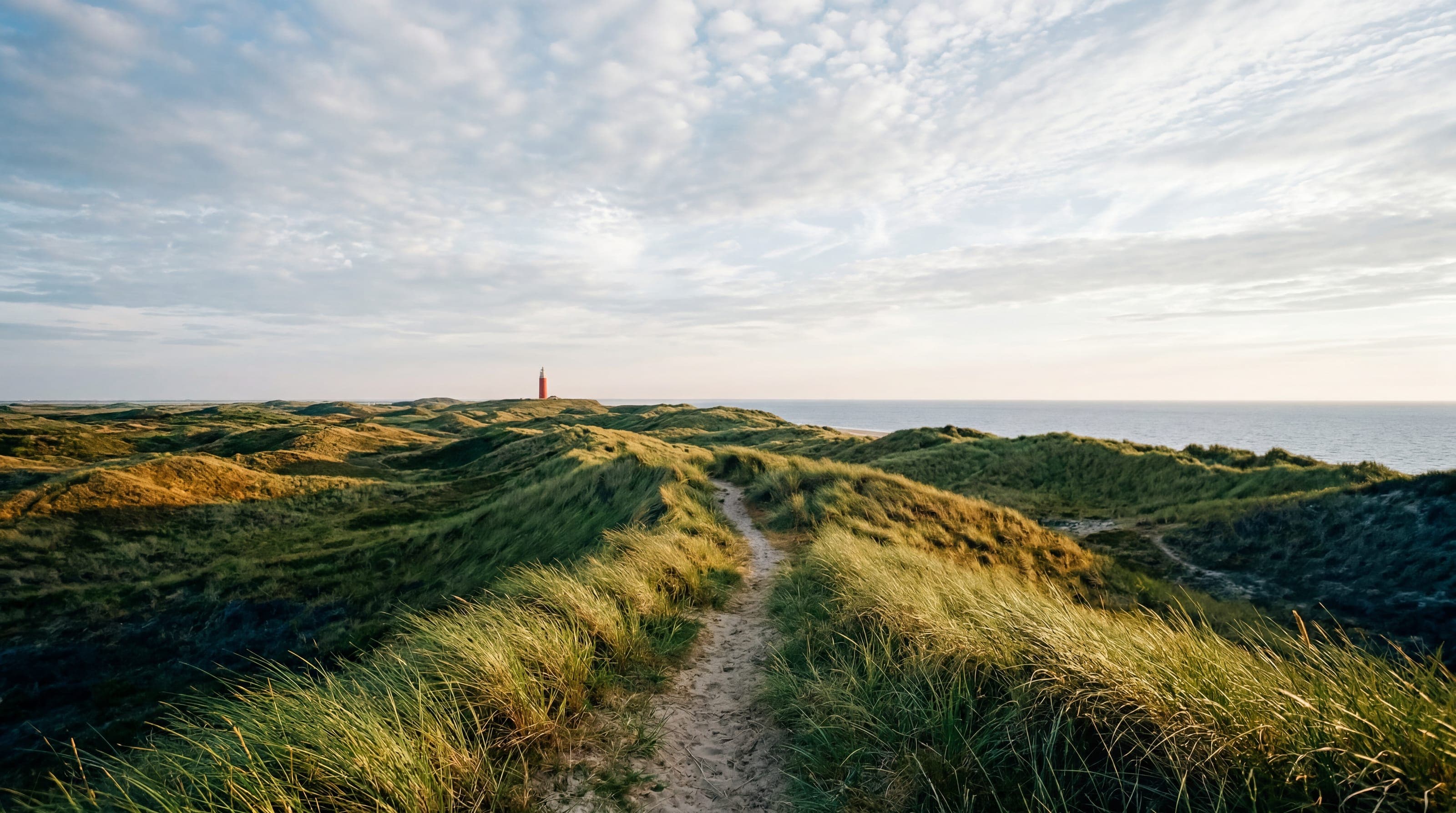
Texel adds nature and breathing room to a Netherlands itinerary, especially for travelers who think the country is only canals and museums.
Texel sits a 20-minute ferry ride off the tip of North Holland and runs on a different clock. Plan around bikes, tides and wind rather than opening hours, and give it at least one night if you can.
Best time to visit Texel
May to September is beach weather. Late spring and early autumn are the sweet spot: roughly 15 to 25 degrees, everything open, noticeably fewer people. September is quiet cycling weather.
The crunch periods are the Dutch and German school holiday weeks. TESO's ferry pricing doubles as a busy-days signal: cars pay roughly 50 percent more Friday through Monday than Tuesday to Thursday, so midweek is the easiest saving.
Off-season works too: the Dutch treat Texel as a year-round place to "uitwaaien" (blow the cobwebs out), with overnight bike trips even in February.
Pegs worth timing a trip around: asparagus on menus from mid-April, De Slufter turning purple with sea lavender in summer, Texel bock beer in autumn.
What genuinely needs booking ahead is not the ferry but summer-holiday accommodation; VVV Texel is the local booking hub. Allow a few weeks' lead for spring and summer weekends.
How to get to Texel: train to Den Helder plus the TESO ferry
The car-free route is easy: intercity train to Den Helder (direct trains run from as far as Maastricht), then a connecting bus timed to the boats. From Amsterdam the whole trip takes about 2 hours. Our guide to travelling the Netherlands by train covers the rail leg; arriving from abroad, check entry requirements for 2026 first.
The TESO ferry from Den Helder to 't Horntje sails hourly, half-hourly on busy days. You cannot reserve it: you turn up and take the next boat.
Every ticket is a return, bought only on the Den Helder side; the trip back is unchecked. Returning by public transport, leave the boat on the right for the free bus to Den Helder station.
A foot passenger return costs a few euros; under-4s travel free. Buying the car ticket online enables license-plate recognition and faster boarding on summer weekends. Fares change periodically; check teso.nl for current prices.
Honestly, consider leaving the car on the mainland: parking is paid island-wide, and short-stay visitors routinely do Texel car-free.
Where to stay on Texel: which village to choose
Should you stay overnight? For most people, yes: the day trip from Amsterdam works, but at about 2 hours each way it fights the island's slow pace.
The villages have distinct personalities:
- Den Burg: the capital, most shops and restaurants.
- De Koog: beach resort near Ecomare; most facilities, and the one properly touristy strip.
- De Cocksdorp: quiet north end, near the Eierland lighthouse.
- Den Hoorn and Oosterend: the prettiest, most frozen-in-time villages; the "real Texel".
- Oudeschild: the harbour village, with seal boats, the brewery and fishing character.
The range is unusually wide: over 90 campsites in dunes, woods and farmland, bungalow parks (De Krim is the big family option, with pool), hotels up to four-star, and a StayOkay hostel in Den Burg. See where to stay in the Netherlands on a first trip for how Texel fits a wider base strategy.
Getting around the island: bikes, bus 28 and the Texelhopper
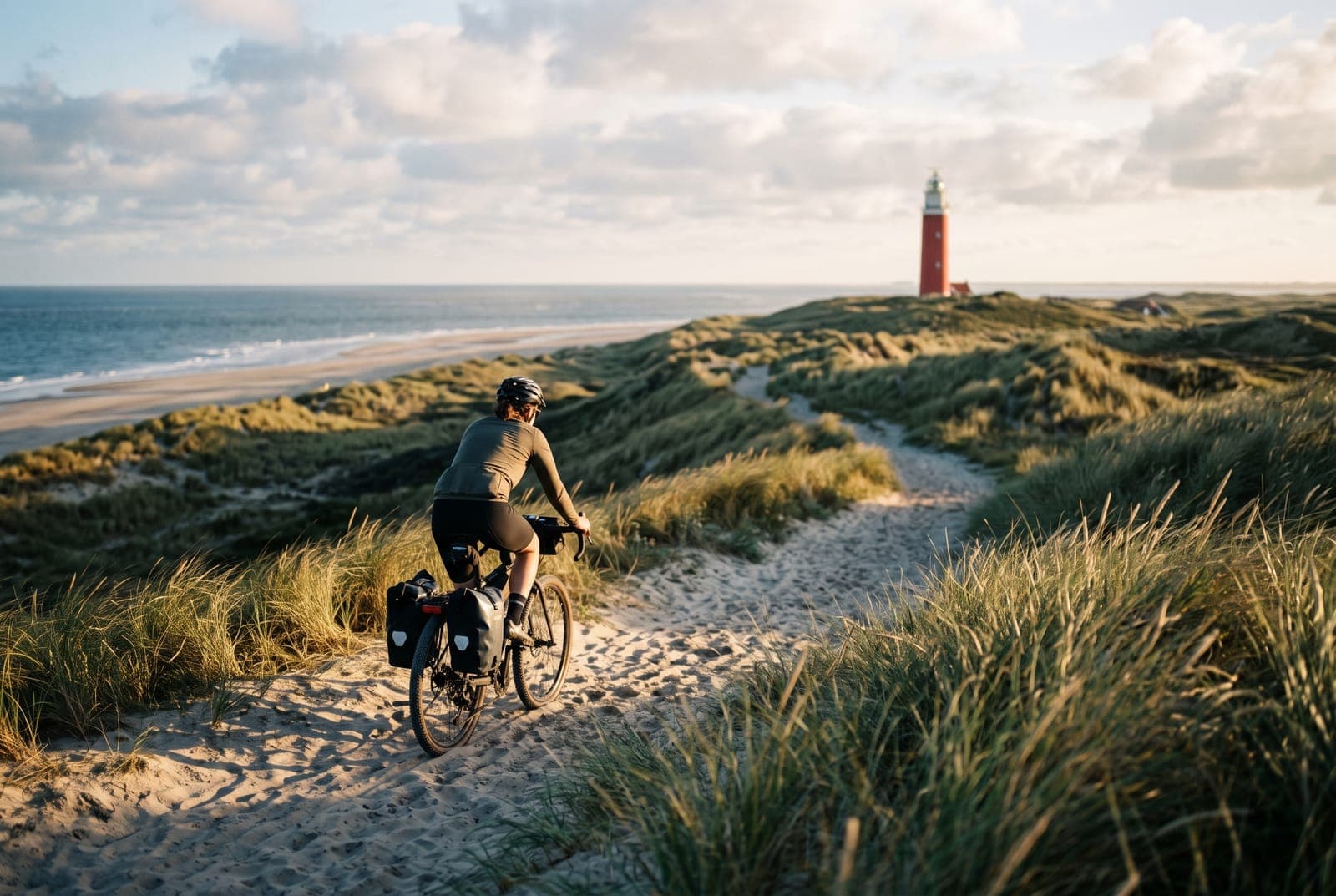
Cycling is the organizing activity. Around 140 km of cycle paths cross dunes, forest and polders on the numbered knooppunt network. Rentals are everywhere, including right off the ferry at Pontweg 2, and prices are effectively uniform island-wide, so do not shop around.
The North Sea wind can turn a ride into a slog; head out into the wind and come home with it.
Without a bike, bus 28 links the ferry, Den Burg and De Koog and meets every boat. Everywhere else, use the Texelhopper, an on-demand minibus serving around 200 stops; book at least 30 minutes ahead by app or phone. Rides cost a few euros, day passes exist, and kids up to 11 ride free.
If you drive anyway: parking is paid in all villages and at every beach entrance during daytime hours, typically until early evening, at card-only machines (see our money essentials); some village centres have 2-hour blue-disc zones. The license-plate e-vignette from texelvignet.nl is the least painful option.
Beaches use numbered poles, south to north: Ecomare around 17, De Koog 20 and 21, the lighthouse 31 and 32, pavilions at many.
What to do on Texel: seals, dunes and one surprising war story
Wildlife. Ecomare in De Koog is a seal and bird rescue centre with an aquarium; the scheduled seal and porpoise feedings are the draw, so time your visit to one (check the official site for hours and prices). From Oudeschild harbour, seal boats run to the sandbanks: fast motorboats (about an hour and twenty minutes) suit kids, slower fishing-boat trips take around three hours. Departures follow the tide, since seals haul out at low water; operators advertise a 100 percent seal guarantee.
Nature. De Slufter is the signature reserve: the island's only open dune breach to the sea, a tidal salt marsh reached by a roughly 4 km walk from the stairs at the Zanddijk car park. Go early to have it nearly to yourself; the viewpoint at the top of the stairs works for non-walkers. Bring binoculars: over 300 bird species have been recorded, around 80 breeding each spring. From Ecomare, the 4.5 km Alloo trail is wheelchair-accessible with Braille and audio guides. At the north tip, the Eierland lighthouse is climbable for a small fee.
The history nobody expects. In April and May 1945, Texel saw one of the last battles of the Second World War in Europe: the Georgian uprising, which killed more than 500 Georgian soldiers. The Loladze cemetery on the Hoge Berg is free to visit; the small Aviation and War Museum in De Cocksdorp tells the story.
Families. Oudeschild harbour has free playgrounds, including a 35-metre pirate ship and a water playground; add the Catharinahoeve pancake farm, plus petting and ice-cream farms.
The point of a Wadden island is doing very little, well: walk, cycle, sit on a beach. For the core loop packaged, our Texel dunes, bike and seal day covers it.
What to eat and drink: lamb, sheep's cheese and Skuumkoppe
Order by product, not by restaurant. Texel lamb has been an export for centuries; sheep's cheese has been made here since the mid-1500s. From the sea: Wadden shrimp, mussels, and oysters you can pick yourself off the mudflats with boots and a bucket. Saline vegetables like sea kraal and sea lavender turn up on better menus.
The Texels brewery in Oudeschild runs tours; Skuumkoppe is its flagship, and autumn brings the bock season. There is also TX Gin, Texel whisky from Distillery de Lepelaar, and Juttertje liqueur. Farm stops double as activities: Labora ice cream in De Cocksdorp and the Novalishoeve organic dairy.
Look for the "Echt Texels Product" quality mark; it does the vetting for you.
A realistic day on Texel (and how to dodge the crowds)
A good car-free day: early ferry, bike pickup at the terminal, De Slufter while it is near-empty, Ecomare timed to a seal feeding, lunch in Den Hoorn or Oosterend, an afternoon seal boat from Oudeschild or beach hours, late ferry back. Better: stay the night and split it over two slower days.
Crowd tactics in one place: cross midweek, hit De Slufter early, and eat in Den Hoorn, Oosterend or Oudeschild rather than De Koog.
Check the wind before committing to a long loop, and know De Slufter can flood or close a few times a year after storms.
If you need sights-per-hour, keep Texel to one slow day and spend the rest on the mainland.
Where to go after Texel
Den Helder is a transit town; do not linger. The rail line back passes Alkmaar, the cheese town, a natural break on the way to Amsterdam or Haarlem.
The Wadden Sea is a UNESCO site; tide-dependent mudflat excursions and seasonal Vlieland connections run from the De Cocksdorp area, so verify current operators. One trap: Vlieland and Terschelling normally depart from Harlingen, a different trip entirely.
Giethoorn and Groningen continue the slow, beyond-the-canals thread Texel starts. Slot the island in as the nature break in our 10 days in the classic Netherlands route, or add it to the 3 days in Amsterdam plan as a one- or two-night extension.
- Netherlands entry requirements in 2026A practical, date-aware guide to passports, 90/180-day rules, EES border checks and ETIAS timing for Netherlands visitors.
- Is the I Amsterdam City Card worth it?The city card can be excellent value, but only for active plans. This guide shows when to buy it and when to skip it.
- How to travel the Netherlands by trainThe Netherlands is rail-friendly, but visitors still need help choosing between contactless payment, day tickets and regional passes.
Top things to do in Texel
Hand-picked experiences in Texel
The places, experiences and stays our editors return to in Texel.
Map
Map of Texel
Pinned listings on the map. Tap a pin to open.
More in Texel