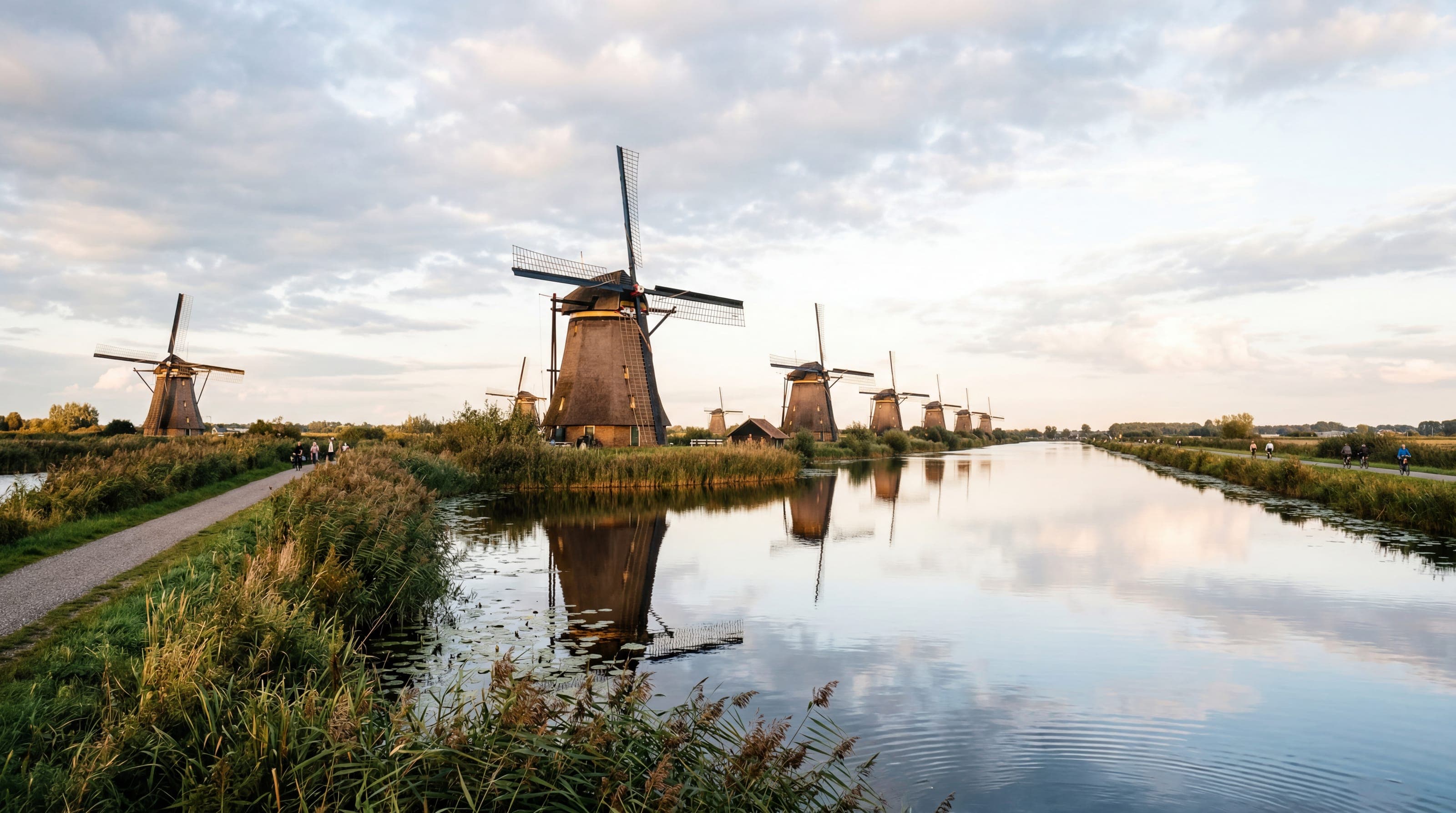
Kinderdijk is more than windmill scenery: it explains how the Netherlands lives with water, which makes it a stronger editorial and trust-building page.
The mills line the drainage canals of the Alblasserwaard polder, about 30 minutes from Rotterdam by boat. You can see them for free at any hour; the paid site explains why they exist. This page covers both, plus the transport quirks that catch people out.
Why the Kinderdijk windmills matter (and why the site still works)
Nineteen mills went up around 1738-1740 to pump water out of the polder, joining the older Blokweer mill of 1630. UNESCO listed the ensemble in 1997 as the "Mill Network at Kinderdijk-Elshout" because it shows the complete Dutch water toolkit in one view: dikes, reservoirs, windmills and pumping stations.
That toolkit still runs. The 1868 Wisboom pumping station marks the steam era, and modern pumps do the heavy lifting today, the latest chapter in 700-plus years of keeping land below sea level dry.
The St. Elisabeth's Flood of 1421 reshaped this region, and the name Kinderdijk ("children's dike") comes from a legend about a child found alive after that flood.
Roughly 60 people still live in the mills. This is a working village, not an open-air museum set. The paid heritage core, covered in our Kinderdijk UNESCO windmills listing, funds the conservation that keeps it that way.
How to get to Kinderdijk from Rotterdam, Amsterdam and Dordrecht
The best route is the WaterShuttle from Rotterdam: direct, under 30 minutes, and bikes travel free on board. Two catches. It is not part of the public transport network, so you need a separate ticket, or the Combiticket that bundles the boat with site admission at a discount. And the schedule is seasonal and changes yearly, so check the current timetable.
The regular Waterbus via Ridderkerk (transfer toward Krimpen aan de Lek) is the fallback when no direct boat runs, historically the winter option. Last boats back have run as early as around 17:00 in past seasons, so check return times when you board.
By land, bus 489 from Rotterdam P+R Beverwaard stops near the ticket office, and buses run year-round from both Rotterdam and Dordrecht to the site entrance.
In 2026, high season runs 16 March to 1 November and you cannot park at the mills at all: parking is only at the Transferium in Alblasserdam (Kabelbaan 1), 9.75 euros per car including a free shuttle bus, sold only with an admission ticket. In low season the Transferium closes and you park at the site entrance at Nederwaard 1, same price, same admission-ticket condition, with no online parking reservation. Dates and prices reset each season, so verify on the official site before you drive.
From Amsterdam, take the Intercity to Rotterdam Centraal and then the boat; driving takes about an hour from Amsterdam, 30 minutes from Rotterdam. Our guide to how to travel the Netherlands by train covers the rail leg.
Kinderdijk tickets and opening hours: what's free and what you pay for
The biggest misconception first: you do not have to pay to see Kinderdijk. The dike paths and the windmill views are free and open at all times. The ticket buys the interiors, the canal boat and the exhibitions: understanding rather than viewing.
If you do buy, buy online. Walk-up prices in 2026 are 21 euros for adults, 9 euros for children aged 4 to 12, free under 4, and booking online gives an automatic 10 percent discount. Paying at the desk wastes that.
One ticket covers everything inside the paid zone: both museum mills, the canal tour boat, the Wisboom Pumping Station, the film in pumping station De Fabriek, the bird theater and the app audio tours.
Hours in 2026: 9:00 to 17:30 from 6 March to 1 November, then 10:30 to 16:00 from 2 November to the end of December, closed on Christmas Day. Hours and prices reset each season, so confirm on the official Kinderdijk site.
Combining Kinderdijk with Rotterdam, Delft or The Hague? The RET Tourist Day Ticket covers buses, metro and ferries across South Holland and can pay for itself, but confirm whether it covers the WaterShuttle, which sits outside public transport.
Best time to visit Kinderdijk: seasons, crowds and golden hour
May through September gives you the long light; shoulder-season weekdays give you space.
The first 60 to 90 minutes after opening are noticeably calmer. From 11:00 to 14:00 the tour groups and river-cruise excursions land.
With a car, sunset is the quiet window. In July the sun sets around 22:00, the paid site is long closed, and the free dike path is nearly empty.
Early September brings the annual Illumination Week: mills lit at night, evening boat tours, kayaking and an evening opening of a museum mill. Dates change yearly, so check ahead.
Is it a tourist trap? No: this is a working water landscape with residents. Midday in July still feels crowded, though. Timing, not skipping, is the fix.
Seeing the site: walking route, boat and bikes
Budget at least two hours. One hour only gets you to the second bridge, and walking the full paths is roughly 10,000 steps. Bring comfortable shoes, layers and rain gear.
Take the paid core in order: the Nederwaard museum mill (1738, former home of the Hoek family, with their original furniture and photos), the Blokweer museum mill (1630, the oldest on site), the Wisboom Pumping Station, and the film at De Fabriek.
The hop-on-hop-off boat included with your ticket is the low-effort way to cover the site's length. Good for kids, tired legs and short visits.
Cycling is how locals move here. Rent at Café De Klok near the entrance (historically around 10 euros a day) or bring your own free on the WaterShuttle. The dike and polder cycle paths continue beyond the paid zone.
Two etiquette points. Drones are banned, with clear signage, because people live here. And the non-museum mills are homes: gardens and doorsteps are not photo props. Our etiquette essentials cover the wider Dutch version.
Where to eat and whether to stay overnight
Food options are thin. Café De Klok and Grand Café Buena Vista sit near the entrance serving Dutch standards at slightly elevated prices, and there is a visitor-center café.
The smart move is a supermarket picnic bought in Rotterdam before you board. The site has designated picnic areas.
There is no meaningful accommodation in Kinderdijk village, so do not try to stay "at the mills". Base in Rotterdam for the fast boat link, or in Dordrecht to cycle in for sunrise or sunset instead of wrestling bus connections (about an hour with transfers). For picking a base, see where to stay in the Netherlands on a first trip.
A realistic half-day plan (and the last-boat trap)
Take a morning WaterShuttle from Rotterdam so you arrive near opening, in the calm first 90 minutes. Do the museum mills and the Wisboom Pumping Station first, then use the included boat or a bike to cover the far end. Picnic, then be back on the water by mid-afternoon.
That deadline is not optional. Last boats back have run as early as around 17:00, and missing them means the slow bus workaround. Check the return timetable on arrival.
Spend the other half in Rotterdam: architecture, food halls, museums, all 30 minutes away by boat. Or run the plan in reverse and drive or cycle in for the evening to shoot the free dike paths at golden hour.
From Amsterdam, the day trip works but it is long: train to Rotterdam Centraal plus the boat, both ways. A Rotterdam base is better.
After the windmills: how Kinderdijk fits a longer trip
The Waterbus corridor links Rotterdam, Kinderdijk and Dordrecht, so both cities are natural next stops. Dordrecht is an underrated base with a scenic bike ride back to the mills. If you kept the bike, the Alblasserwaard polder beyond the paid zone is open cycling country.
Choosing between Kinderdijk and Zaanse Schans? They are different animals: Zaanse Schans is the easy open-air showcase near Amsterdam, Kinderdijk a working water-management landscape. Most trips need only one. Pick Zaanse Schans for an easy half-day from Amsterdam; pick Kinderdijk to understand how the country stays dry.
In a longer itinerary, Kinderdijk slots in as a half-day within 7 days across Amsterdam, Delft, Rotterdam and The Hague or 10 days in the classic Netherlands. Nearby bases like Delft and The Hague also work, especially with the RET Tourist Day Ticket.
- 7 days across Amsterdam, Delft, Rotterdam and The Hague7 days · museums · architecture
- 10 days in the classic Netherlands10 days · canals · waterworks
- Netherlands entry requirements in 2026A practical, date-aware guide to passports, 90/180-day rules, EES border checks and ETIAS timing for Netherlands visitors.
- Is the I Amsterdam City Card worth it?The city card can be excellent value, but only for active plans. This guide shows when to buy it and when to skip it.
- How to travel the Netherlands by trainThe Netherlands is rail-friendly, but visitors still need help choosing between contactless payment, day tickets and regional passes.
Top things to do in Kinderdijk
Hand-picked experiences in Kinderdijk
The places, experiences and stays our editors return to in Kinderdijk.
Map
Map of Kinderdijk
Pinned listings on the map. Tap a pin to open.
More in Kinderdijk